Ví dụ: Số học đồng dư giúp đơn giản hóa các bài toán tìm số dư với số mũ rất lớn.
arithmetic addition
/əˈrɪθmətɪk əˈdɪʃən/
English definition coming soon.
VIphép cộng số học
arithmetic average
/əˈrɪθmətɪk ˈævərɪdʒ/
English definition coming soon.
VItrung bình cộng
arithmetic division
/əˈrɪθmətɪk dɪˈvɪʒən/
English definition coming soon.
VIphép chia số học
arithmetic mean
/əˈrɪθmətɪk miːn/
The sum of a collection of numbers divided by how many numbers are in the collection, commonly called the average.
VItrung bình cộng
Example: The arithmetic mean of a and b is (a + b)/2.
Ví dụ: Trung bình cộng của hai số a và b là (a + b)/2.
arithmetic progression
/əˈrɪθmətɪk prəˈɡreʃən/
An ordered sequence of numbers in which each term after the first is obtained by adding a fixed constant difference to the preceding term.
VIcấp số cộng
Example: In the arithmetic progression 3, 7, 11, 15, …, the common difference is d = 4.
Ví dụ: Trong cấp số cộng 3, 7, 11, 15, …, công sai là d = 4.
arithmetic sequence
/əˈrɪθmətɪk ˈsiːkwəns/
A sequence of numbers with a constant difference between consecutive terms, given by aₙ = a₁ + (n − 1)d.
VIcấp số cộng
Example: The nth term of an arithmetic sequence is aₙ = a₁ + (n − 1)d.
Ví dụ: Số hạng tổng quát thứ n của cấp số cộng là uₙ = u₁ + (n − 1)d.
arithmetic series of higher order
English definition coming soon.
VIchuỗi số học cấp cao, cấp số cộng cấp cao
arithmetic sum
/əˈrɪθmətɪk sʌm/
English definition coming soon.
VItổng số học
arithmetic unit
/əˈrɪθmətɪk ˈjuːnɪt/
English definition coming soon.
VIđơn vị số học, bộ số học
arithmetical
English definition coming soon.
VI(thuộc) số học
arithmetical circuit
English definition coming soon.
VImạch số học
arithmetical difference
English definition coming soon.
VIhiệu số số học
arithmetical invariant
English definition coming soon.
VIbất biến số học
arithmetically
English definition coming soon.
VItheo số học về mặt số học
arithmetics chart
English definition coming soon.
VIbiểu đồ những thay đổi số lượng
average
/ˈævərɪdʒ/
A single representative value for a data set, most commonly the arithmetic mean obtained by dividing the sum of all values by their count.
VItrung bình, trung bình cộng
Example: The average of 12, 15, and 21 is (12 + 15 + 21)/3 = 16.
Ví dụ: Trung bình cộng của 12, 15 và 21 là (12 + 15 + 21)/3 = 16.
B (3 mục)
Bhaskara II
Bhaskara II, also called Bhaskaracharya, was born in India in 1114. His Lilavati treats arithmetic and mensuration. His Bijaganita presents algebraic methods, including the cyclic chakravala method for finding integer solutions to a class of quadratic equations.
VIBhaskara II, còn gọi là Bhaskaracharya, sinh năm 1114 tại Ấn Độ. Lilavati của ông trình bày số học và đo đạc hình học. Trong Bijaganita, ông trình bày các phương pháp đại số, trong đó có phương pháp vòng lặp chakravala để tìm nghiệm nguyên của một lớp phương trình bậc hai.
Blaise Pascal
Blaise Pascal (1623–1662) was a French mathematician and physicist. He studied how the arithmetic triangle gives binomial coefficients. His correspondence with Fermat about dividing stakes in an interrupted game helped lay the foundations of probability theory.
VIBlaise Pascal (1623–1662) là nhà toán học và vật lý người Pháp. Ông nghiên cứu cách dùng tam giác số học để tính hệ số nhị thức. Trao đổi của ông với Fermat về cách chia tiền cược trong một ván chơi bỏ dở góp phần đặt nền móng cho lý thuyết xác suất.
Brahmagupta
Brahmagupta (born 598 CE) was an Indian mathematician and astronomer. His Brahmasphutasiddhanta (628) gives arithmetic rules for zero and negative numbers. Brahmagupta’s formula gives the area of a cyclic quadrilateral from its four side lengths.
VIBrahmagupta (sinh năm 598) là nhà toán học và thiên văn Ấn Độ. Trong Brahmasphutasiddhanta (628), ông nêu các quy tắc tính toán với số 0 và số âm. Công thức Brahmagupta cho phép tính diện tích tứ giác nội tiếp từ độ dài bốn cạnh.
C (5 mục)
calculate
/ˈkælkjuleɪt/
To determine a numerical answer or mathematical result by applying arithmetic operations, formulas, or logical steps.
VItính toán
Example: Calculate the area of the shaded region in terms of π.
Ví dụ: Tính diện tích phần tô đậm theo π.
Carl Friedrich Gauss
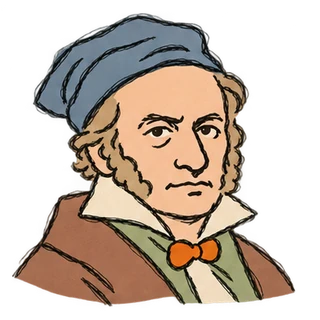
Carl Friedrich Gauss (1777–1855) was a German mathematician who directed the Göttingen observatory. His Disquisitiones Arithmeticae (1801) systematized modular arithmetic and presented a proof of quadratic reciprocity.
VICarl Friedrich Gauss (1777–1855) là nhà toán học Đức, từng làm giám đốc đài thiên văn Göttingen. Trong Disquisitiones Arithmeticae (1801), ông hệ thống hóa số học đồng dư và trình bày chứng minh luật tương hỗ bậc hai.
common difference
/ˈkɑːmən ˈdɪfərəns/
The fixed constant added to each term to obtain the next term in an arithmetic sequence.
VIcông sai (cấp số cộng)
Example: Subtract any term from the next to find the common difference of an arithmetic sequence.
Ví dụ: Lấy một số hạng trừ đi số hạng liền trước để tìm công sai của cấp số cộng.
compute
/kəmˈpjuːt/
To determine a mathematical value or result systematically using arithmetic, algebraic manipulation, or an algorithm.
Ví dụ: Tính nhanh 999 × 1001 bằng hằng đẳng thức (1000 − 1)(1000 + 1) = 999.999.
congruencen
/ˈkɑːŋɡruəns/
Exact equality of shape and size in geometry, or the relation in modular arithmetic where two integers leave the same remainder upon division.
VIsự bằng nhau (hình học); đồng dư
Example: In modular arithmetic, 17 ≡ 2 (mod 5) is a congruence modulo 5.
Ví dụ: Trong số học đồng dư, 17 ≡ 2 (mod 5) là một đồng dư thức theo mô-đun 5.
D (3 mục)
Diophantus of Alexandria
Diophantus was a mathematician in Alexandria, usually placed in the third century CE. In his Arithmetica he sought positive rational solutions to many algebraic problems and used abbreviations for unknowns. Today a Diophantine equation usually asks for integer solutions.
VIDiophantus là nhà toán học ở Alexandria, thường được xếp vào thế kỷ III. Trong bộ Arithmetica, ông tìm nghiệm hữu tỉ dương cho nhiều bài toán đại số và dùng các ký hiệu viết tắt cho ẩn số. Ngày nay, phương trình Diophantus thường chỉ phương trình cần tìm nghiệm nguyên.
divided by
/dɪˈvaɪdɪd baɪ/
An arithmetic phrase indicating the division of the preceding dividend by the following divisor, symbolized by ÷ or /.
VIchia cho (÷)
Example: Thirty-six divided by nine equals four.
Ví dụ: Ba mươi sáu chia cho chín bằng bốn.
division
/dɪˈvɪʒən/
The arithmetic operation inverse to multiplication that splits a dividend into equal groups or finds how many times a divisor fits.
VIphép chia
Example: Division by zero is undefined in arithmetic and algebra.
Ví dụ: Phép chia cho 0 không xác định trong số học và đại số.
F (2 mục)
factorization
/ˌfæktərəˈzeɪʃən/
The process or result of rewriting an integer or algebraic expression as a product of factors.
VIsự phân tích thành nhân tử / thừa số
Example: Unique prime factorization is the fundamental theorem of arithmetic.
Ví dụ: Sự phân tích duy nhất ra thừa số nguyên tố là định lý cơ bản của số học.
Fibonacci
Fibonacci, also called Leonardo of Pisa, was an Italian mathematician active in the early thirteenth century. His Liber Abaci (1202) helped spread Hindu–Arabic arithmetic in Europe. Its rabbit problem leads to the sequence in which each term after the first two is the sum of the preceding two.
VIFibonacci, tên thật là Leonardo xứ Pisa, là nhà toán học Ý hoạt động vào đầu thế kỷ XIII. Sách Liber Abaci (1202) phổ biến cách tính bằng hệ chữ số Ấn Độ–Ả Rập ở châu Âu. Bài toán thỏ trong sách dẫn đến dãy số mà mỗi số hạng sau hai số đầu bằng tổng hai số đứng trước.
H (1 mục)
Hypatia of Alexandria
Hypatia (died 415 CE) taught mathematics, astronomy and philosophy in Alexandria. Ancient sources associate her with commentaries on Diophantus’ Arithmetica and Apollonius’ Conics.
VIHypatia (mất năm 415) là nhà toán học, thiên văn và triết gia giảng dạy ở Alexandria. Các nguồn cổ gắn tên bà với những chú giải về Arithmetica của Diophantus và bộ Đường conic của Apollonius.
M (3 mục)
mean
/miːn/
The arithmetic average of a set of numbers, calculated by dividing the sum of all values by the number of values.
VItrung bình cộng
Example: If the mean of five numbers is 14, then their sum is 5 × 14 = 70.
Ví dụ: Nếu số trung bình cộng của năm số bằng 14 thì tổng của chúng bằng 5 × 14 = 70.
mental arithmetic
English definition coming soon.
VItính nhẩm
multiplication
/ˌmʌltɪplɪˈkeɪʃən/
The arithmetic operation of combining equal groups or scaling one quantity by another, denoted by × or ⋅.
VIphép nhân
Example: Multiplication distributes over addition: a(b + c) = ab + ac.
Ví dụ: Phép nhân có tính chất phân phối đối với phép cộng: a(b + c) = ab + ac.
N (1 mục)
Nicomachus of Gerasa
Nicomachus was a mathematician in the Pythagorean tradition from Gerasa, in present-day Jordan. His Introduction to Arithmetic discusses classes of positive integers such as primes, perfect numbers and numbers represented by polygonal patterns.
VINicomachus là nhà toán học theo truyền thống Pythagoras, quê ở Gerasa, nay thuộc Jordan. Tác phẩm Nhập môn số học của ông trình bày các loại số nguyên dương, như số nguyên tố, số hoàn hảo và các số biểu diễn được bằng hình đa giác.
R (3 mục)
recursive arithmetic
English definition coming soon.
VI(lô-gic) số học đệ quy
root mean square
/ruːt miːn skwer/
The square root of the arithmetic mean of the squares of a set of numbers, √((x₁² + … + xₙ²)/n).
VIcăn quân phương
Example: By the QM-AM inequality, the root mean square √((a² + b²)/2) is at least (a + b)/2 for a, b ≥ 0.
Ví dụ: Theo bất đẳng thức trung bình toàn phương – trung bình cộng, √((a² + b²)/2) ≥ (a + b)/2 với a, b ≥ 0.
rule of arithmetics
English definition coming soon.
VIquy tắc số học
S (2 mục)
sample mean
/ˈsæmpəl miːn/
The arithmetic average of the observed values in a sample, commonly written x̄ and used to estimate the population mean.
VItrung bình mẫu
Example: As sample size n grows, the sample mean x̄ converges in probability to the population mean μ.
Ví dụ: Khi kích thước mẫu n tăng lớn, trung bình mẫu x̄ hội tụ theo xác suất về kỳ vọng tổng thể μ.
subtraction
/səbˈtrækʃən/
The arithmetic operation of finding the difference between two numbers, denoted by the minus sign (−).
VIphép trừ
Example: Subtraction is the inverse operation of addition.
Ví dụ: Phép trừ là phép toán ngược của phép cộng.
T (1 mục)
times
/taɪmz/
Multiplied by a given factor, indicating the arithmetic operation of multiplication (×).
VInhân với (×)
Example: Seven times eight is fifty-six.
Ví dụ: Bảy nhân tám bằng năm mươi sáu.
Không tìm thấy thuật ngữ phù hợp với từ khóa của bạn.